Lowered, it closes the opening completely: shading, privacy and one more layer in front of the window.
An external roller shutter is a curtain of aluminium slats that coils onto a barrel in a headbox above the opening and comes down guided by two side rails. It is the simplest of the four systems here and, for that very reason, the most widespread.
Unlike a Raffstore, a roller shutter cannot be adjusted in stages: the slats do not tilt, and the system works in practice between two states — raised, with the opening clear, and lowered, with the opening closed. Lowered, on the other hand, it does three things at once: it stops the light, closes off the view from the street and puts a physical element in front of the window.
An external roller shutter is usually chosen for more than shading. That is also why it remains the preferred solution in housing.
Shading
Lowered, it stops solar radiation before it reaches the glass. As with any external system, the heat stays outside, not in the room.
Darkness on demand
With unperforated slats, the lowered shutter darkens the room. That is why it is so often fitted to bedrooms.
Privacy
It closes off the view from outside completely, with no need for curtains or other solutions indoors.
Extra protection for the opening
Lowered, the shutter adds a physical element in front of the window. It does not replace a dedicated security solution, but neither does it leave the opening uncovered.
It retracts completely
Raised, the slat curtain gathers into the headbox and frees the opening entirely. The system no longer shows in elevation.
Simple mechanical
A single movement, up and down, with no tilting mechanism. Fewer moving parts means less maintenance.
The make-up
What an external roller shutter is made of
Four elements, the same in every system: the headbox, the slat curtain, the side guide rails and the bottom bar. How they are chosen decides how the system looks on the façade.
The slat curtain
Aluminium slats, hinged to one another, that coil onto the barrel. The slat can be perforated or not: the perforations let a little light and air through even with the shutter down.
The headbox
It houses the barrel and the coiled curtain. It can be surface-mounted over the joinery, fitted within the external insulation or built into the masonry. The taller the opening, the more room the coiled curtain takes up.
The side guide rails
Two aluminium profiles at the edges of the opening, which the ends of the slats run in. They keep the curtain straight and stop it coming out of the rail in wind.
The bottom bar
The heavier bottom profile, which tensions the curtain and closes the opening at the foot. The locking elements, where fitted, are mounted on it.
The slat
It is chosen by the height of the opening and by the look wanted. The particular type and thickness are settled on the system chosen, not in general.
The finish
The headbox, the guide rails and the slats are finished in the same colour range as the aluminium joinery, so that the whole reads as one on the façade.
Types of installation
Where the headbox sits
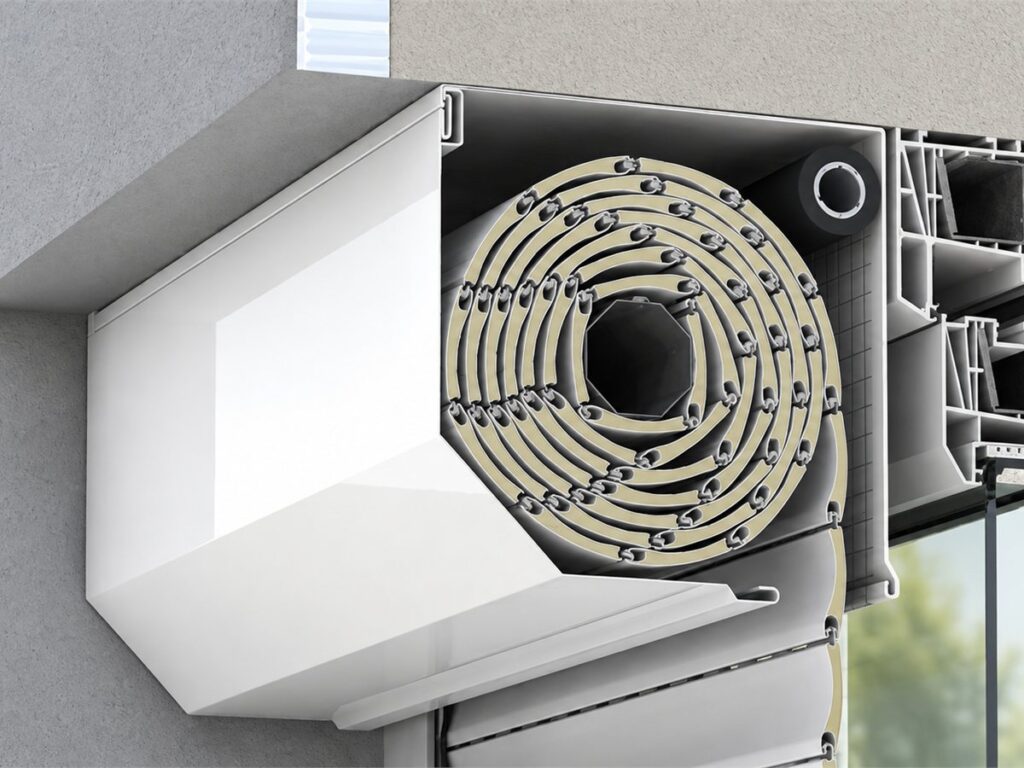
The shutter is the same in all four: a slat curtain, a barrel, guide rails and a bottom bar. What changes is where the headbox sits — and with it, how much room has to be reserved in the opening and how far the system shows on the façade.
Surface-mounted headbox
The headbox is fitted over the joinery, on the face of the wall, and stays visible as a bulk above the opening. Being external, it can be taken down for repairs without touching the façade finish.
Where it fits
On joinery already fitted, because it needs no space allowed for in the masonry
In refurbishments, where the opening can no longer be altered
Where easy access to the barrel and the motor matters
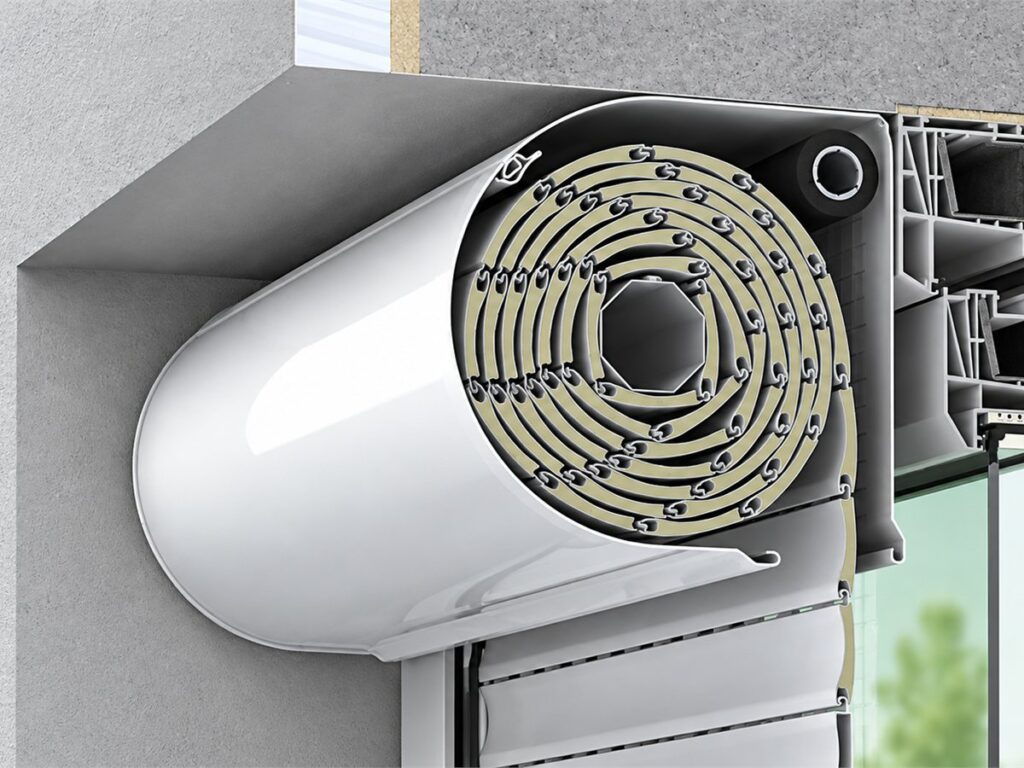
Surface-mounted headbox, with a rounded face
The same way of mounting, with the face of the headbox rounded instead of square. The bulk above the window reads less sharply and the bottom edge no longer cuts the shadow in a straight line.
Where it fits
On façades with curved lines or rounded surrounds
On older buildings, where a square headbox would stand out
When the shutter is surface-mounted but must not look like an afterthought
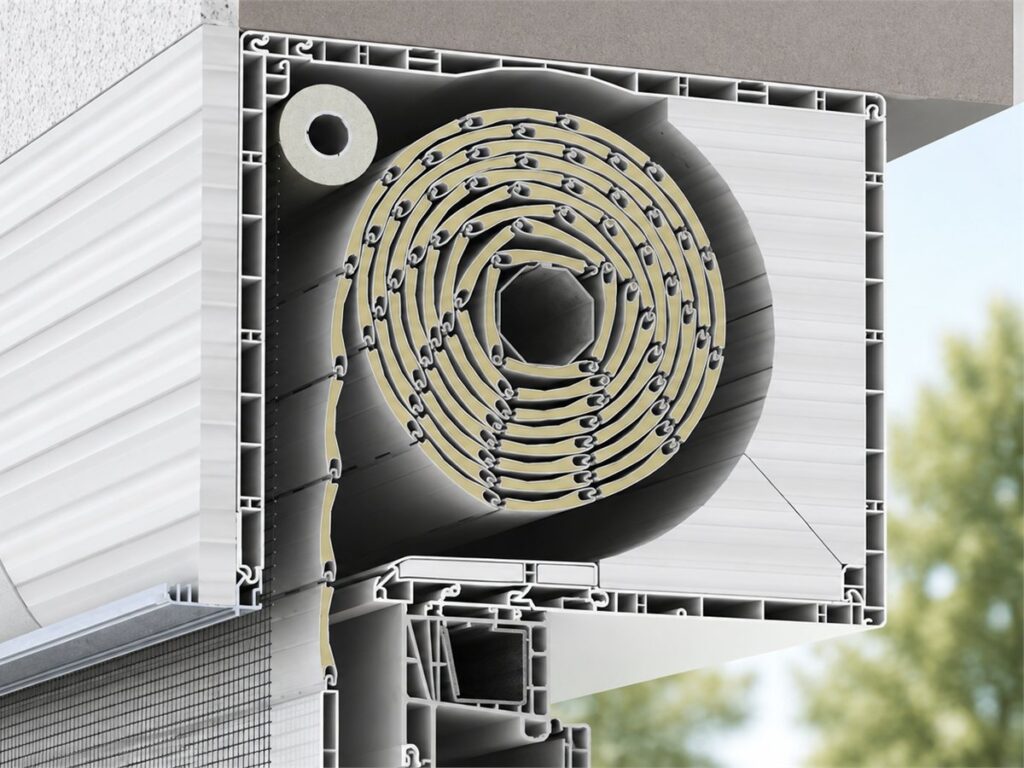
Built-on headbox
The headbox sits directly on the window frame and forms a single assembly with it. It comes from the factory together with the joinery and is clad in the external insulation, so that the façade runs continuously across the opening.
Where it fits
In new build, where the joinery and the shutter are ordered together
Where the façade has external insulation and the headbox can be covered
When a single assembly fitted in one piece is wanted
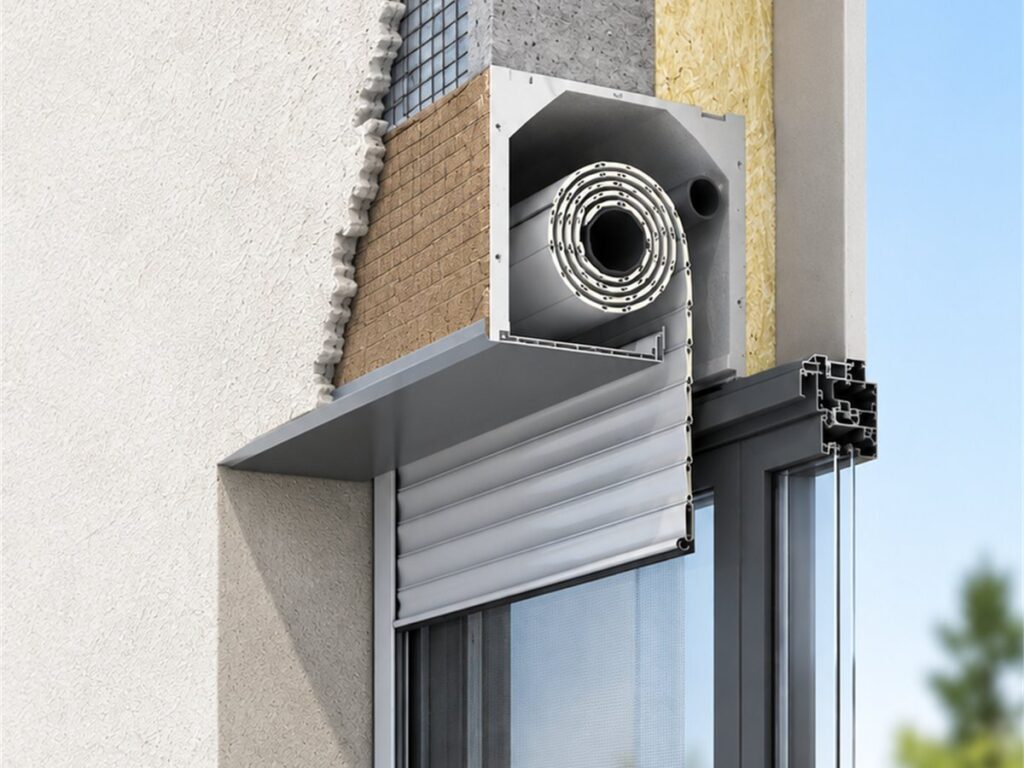
Headbox built into the masonry
The headbox is allowed for in the opening, within the insulation layer, and disappears from the elevation: only the slat curtain and the access panel under the lintel remain visible.
Where it fits
In new build, with the opening sized at design stage
Where the façade has to stay clean, with no bulk above the window
When room for the headbox can be reserved during construction
Operation
Manual or motorised
A shutter has only one movement to control, up and down. The type of operation is settled by the configuration, the size of the opening and the number of windows.
Manual, with a webbing strap or a crank handle
The solution without power, suited to reachable openings and a small number of windows. It becomes awkward on large openings and in buildings with many of them.
Electric motor
A tubular motor inside the barrel. It allows wall control, a remote and, where the system provides for it, integration into an automation.
Group control
Several shutters on the same façade can be operated together, so that the façade reads as one.
Time programming
On motorised systems that allow it, the shutter can lower and raise itself at set times. Useful too when the house is left empty.
Before manufacture
What we decide together
When the decision is taken
The shutter is decided together with the joinery. The headbox and the guide rails need room in the opening or in the external insulation, and that room is allowed for at design stage, not after installation.
The type of installation
Surface-mounted over the joinery, within the external insulation, or in a headbox built into the masonry. Each version changes how the system shows and how it is maintained.
Perforated or unperforated slat
The perforations let light and air through; without them you get darkness. The choice is made room by room, not for the whole house.
The operation
Manual or motorised, with local control, a remote or integration. It is settled before manufacture, because it changes the make-up of the barrel and the electrical runs.
The electrical runs
On the motorised version, power is allowed for at every opening, at services stage. Adding it later means work on the finishes.
The exposure of the opening
The size of the opening, the height it sits at and its exposure to wind decide the configuration. We check them on the actual case, not against a general figure.
Make-up and limits
The slat, the headbox, the guide rail
Three choices that condition one another: the slat gives the appearance and the weight of the curtain, the headbox has to fit the space available, and the guide rail decides how well the curtain holds in wind.
39 mm slat
The standard slat, with the widest colour palette. It is used on most domestic openings and takes every type of headbox.
55 mm slat
The wide slat, for tall openings. It coils into a larger roll, so it needs a bigger headbox, and it has a shorter palette.
Guide rails for built-on systems
The manufacturer supplies a plain PVC rail, a PVC “H”, a combined PVC rail and an aluminium “H”. The “H” profile holds the end of the slat better and keeps the curtain in the rail in wind.
Guide rails for surface-mounted systems
A single guide rail or a double “H” rail, chosen by the width of the opening and by exposure.
Integrated insect screen
The same headbox can also take an insect screen, in a channel of its own in the guide rail. It does however reduce the maximum height of the opening, because two curtains coil into the headbox, not one.
Access to the headbox
Every headbox has access. On the built-on version with a removable cover, the underside of the headbox comes away for repairs without disturbing the surrounding finish.
Maximum areas, by type of operation — systems with a 39 mm slat
Operation
Maximum area
Maximum width
Tape or cord
2,5 m²
2600 mm
Crank handle, spring or electric
6,5 m²
2600 mm
The values are those declared by the manufacturer for systems with a 39 mm slat. The maximum height depends on the headbox chosen and on whether there is an insect screen, and the exact combination is checked on the actual opening, at quotation stage.
Surface-mounted systems with a 55 mm slat, electric operation
The height of the headbox
Maximum height
Maximum area
205 mm
1920 mm
7 m²
250 mm
3380 mm
8 m²
300 mm
4300 mm
8 m²
The version with a 55 mm slat, a surface-mounted headbox and no insect screen is supplied with electric operation only, from a push button or a remote.
Colours and finishes
The roller shutter palette
The slat, the headbox and the guide rails have separate palettes, because they are different parts, finished differently. They can be chosen alike or in contrast — the headbox in the colour of the wall and the slat in the colour of the joinery is the combination asked for most often.
39 mm slat
The widest palette, because this is the slat used on most openings.
White900 · RAL 9016
Beige919 · RAL 1015
Silver916 · RAL 9006
Grey901 · RAL 7038
Rafaello metallic grey911 · RAL 7015
Anthracite grey957
Brown903 · RAL 8014
Reddish brown912 · RAL 8017
Rafaello metallic bordeaux914 · RAL 8016
Green906 · RAL 6005
Blue904 · RAL 5010
Dark brown, Dark Brown921
Light Wood915
Golden920
Dark Wood 1907
Dark Wood 2, walnut910
Walnut925
Golden oak924
Mahogany926
Wenge928
The three-figure codes are the manufacturer’s. Where a RAL code also exists, the swatch reproduces it; the wood-pattern decors have no colour code and are chosen on a sample. For “anthracite grey 957” the manufacturer’s documentation prints an incomplete RAL code, so we do not publish it — we confirm it at order stage.
55 mm slat
The wider slat, for tall openings. Its palette is shorter.
White900 · RAL 9016
Silver916 · RAL 9006
Beige919 · RAL 1015
Grey901 · RAL 7038
Brown903 · RAL 8014
Dark Brown921
Dark Wood 1907
Golden oak924
The swatches with a wood pattern are the samples from the supplier’s documentation, and the coloured ones reproduce the RAL code given. Both are indicative: the final shade is confirmed on a physical sample.
Built-on headboxes and guide rails
For systems fitted over the joinery, with the headbox inside the finish.
WhiteRAL 9016
Anthracite greyRAL 7016
Brown, Dark Brown
Golden oak
Walnut
Black oak
Wenge
Mahogany
The swatches with a wood pattern are the samples from the supplier’s documentation, and the coloured ones reproduce the RAL code given. Both are indicative: the final shade is confirmed on a physical sample.
Surface-mounted headboxes and guide rails
For systems fitted to the face of the wall, where the headbox stays visible.
White
BrownRAL 8014
Brown, Dark Brown
Golden oak
Walnut
Mahogany
The swatches with a wood pattern are the samples from the supplier’s documentation, and the coloured ones reproduce the RAL code given. Both are indicative: the final shade is confirmed on a physical sample.
Operation and automation
From a crank handle to a scene
The operation is chosen before manufacture: it changes the make-up of the barrel, the electrical runs and, sometimes, the size limits. Below are the versions we fit on this type of product.
No power — mechanical operation
Tape or cord
The classic operation, with the webbing strap pulled from inside. It is limited by the area of the slat curtain: the declared maximum for this version is 2.5 m².
Crank handle
A rod with a joint, operated from inside. It raises the area limit to 6.5 m² and remains the power-free option for large openings.
Spring
A spring mechanism that assists the lifting of the slat curtain. Like the crank handle, it needs no power supply.
Switch control — wired motorisation
Somfy tubular motors for roller shutters
For roller shutters Somfy lists the wired WT range: Oximo 50 WT, Ilmo 2 WT, LS 40, LT 50 and Boost 50 WT. They are operated from a wall switch, on an electrical run allowed for at every opening.
SIMU tubular motors
SIMU covers roller shutters with Ø 40, Ø 50 and Ø 60 motors — the T3.5, T5 / T5S and T6 / DMI ranges. The torque is chosen from the manufacturer’s charts, by the weight of the slat curtain, the size of the slat and the height of the curtain.
Radio control — motors with a radio receiver
Somfy RTS
One-way radio at 433.42 MHz, with a rolling code. For roller shutters, Somfy lists Oximo RTS, Oximo short Auto RTS, Altus 40 RTS and Boost 50 RTS.
Somfy io-homecontrol®
Two-way radio, with confirmation from the motor. For roller shutters, the io range comprises RS100 io, Oximo io, Oximo short Auto io and Altus RS io.
SIMU-Hz and SIMU-BHz
SIMU’s own radio. The T5S EHz, T5S Hz.02, T5S AUTO®SHORT Hz and DMI 5 Hz.01 motors have the receiver built in; for wired motors there is a separate Hz receiver.
No electrical run — solar motorisation
Somfy RS100 Solar io
A motor powered from a photovoltaic panel, fitted without any new electrical run.
SIMU AUTOSUN 2
A self-contained kit: motor, battery and solar panel, radio controlled. SIMU declares 45 days of autonomy without sun, at two cycles a day, and an IP44 battery housing.
Roller shutters are routinely fitted with Somfy Oximo and RS100 motors, in mains or solar versions. The exact motor and torque are settled on the actual opening, by the weight of the slat curtain.
Control technologies
What RTS, io and TaHoma mean
Three levels, in increasing order: a wall switch, a radio remote and a unit that ties everything into a scene. They can be added later, but the motor has to be chosen from the outset for the level wanted.
Wired control
A switch wired directly to the motor. The simplest and the cheapest solution, but it needs an electrical run at every opening and does not centralise easily.
Somfy RTS
One-way radio at 433.42 MHz, with a rolling code and 16 million combinations. The command is transmitted three times, to be sure of arriving. Somfy declares a range of 20 m through two concrete walls or 200 m in the open. The motor carries out the command but does not confirm it.
Somfy io-homecontrol®
Two-way radio: the motor confirms what it has done and reports its position. It scans three frequencies between 868 and 870 MHz and picks the free one, and the communication is encrypted on 128 bits. The same declared range as RTS.
SIMU-Hz and SIMU-BHz
SIMU’s own radio, with the receiver built into the motor or separate. The BHz range also works in the 868–870 MHz band. It is used where the motorisation is SIMU.
Somfy TaHoma
The unit that ties the equipment into a single app: remote control, groups, timed programmes and scenes. Somfy has supplied it since 2008 and declares compatibility with over 280 products, including through the io-homecontrol® partners’ protocols.
Control points
Smoove wall switches, Situo and Telis remotes, Nina io and Nina Timer io screens. Roller shutters are routinely operated from a Smoove or a Situo remote, and io systems can be added to TaHoma.
Sensors — the automation that works on its own
Sun sensor
It lowers the shading when the radiation passes the set threshold and raises it when the radiation falls. Somfy lists Sunis io Wirefree in the io range and Soliris RTS, which combines sun and wind, in the RTS range. SIMU has an external sun sensor in the BHz range.
Wind sensor
It retracts the system before the wind loads it. Somfy lists Eolis RTS, Eolis 3D io and Eolis Wirefree io. It has to be discussed on screens and awnings, where the fabric is the exposed part.
Temperature sensor
Thermis io measures the temperature and can start the shading before the room heats up. It works on the same io network as the rest of the equipment.
The sensors and the control units are chosen to match the motor’s technology: an io sensor does not control an RTS motor, or the other way round. Which is why the technology is settled together with the motor, not after installation.
A professional note
Maximum dimensions and classes are declared per system
External roller shutters come under the same product standard as other external shutters and blinds, EN 13659, and wind resistance is tested to EN 1932. The class obtained is not a property of the product in general but of one particular configuration: the same system is classified differently on a narrow opening and on a wide one.
That is why you will not find classes, slat thicknesses, maximum dimensions or motor ratings on this page. We settle them at quotation stage, on the actual opening, and record them in the project documentation, with the declaration of the manufacturer of the system chosen.
The maximum dimensions, the declared classes, the profile sections and the drive data belong to the particular system and to the configuration ordered. We settle them at quotation stage and send them to you with the manufacturer’s documentation.
Technical documentation
Do you need the data sheet?
Tell us the dimensions of the openings and the type of installation. We will send you the data sheet for the right system, for the configuration you are interested in.
Send us the dimensions of the openings and tell us whether the joinery is already fitted or still to come. We will come back with the right configuration and a quotation.
On an ordinary visit, this site places no cookies of its own and uses no traffic analytics, advertising or tracking. We ask for your consent only for content hosted by others — the map and the virtual tour — because it transmits your IP address to the provider.
A single cookie, mcv_cookies, which remembers the choice you make on this screen so that we do not have to ask again on every page. It is kept for six months and stays on this site. The other cookies in this category appear only for those who log in to the administration area of the site.
The Google map on the contact page and the Matterport virtual tour on the home page. If you accept, they load by themselves and may place their own cookies. If you refuse, they stay blocked, and in their place you see a button you can press at any time, for that one piece of content only.
We have no analytics, advertising or social media categories, because the site uses no such tools. If they ever appear, they will appear here too, with the toggle switched off.